
SCALLY INSIGHTS
Sales Infrastructure vs CRM: What's the Difference?
A CRM is a tool. Sales infrastructure is the system that makes your sales operation work.
A CRM helps you store and manage customer and prospect information. Sales infrastructure connects your people, processes, systems, data and workflows so opportunities can move consistently from lead to revenue.
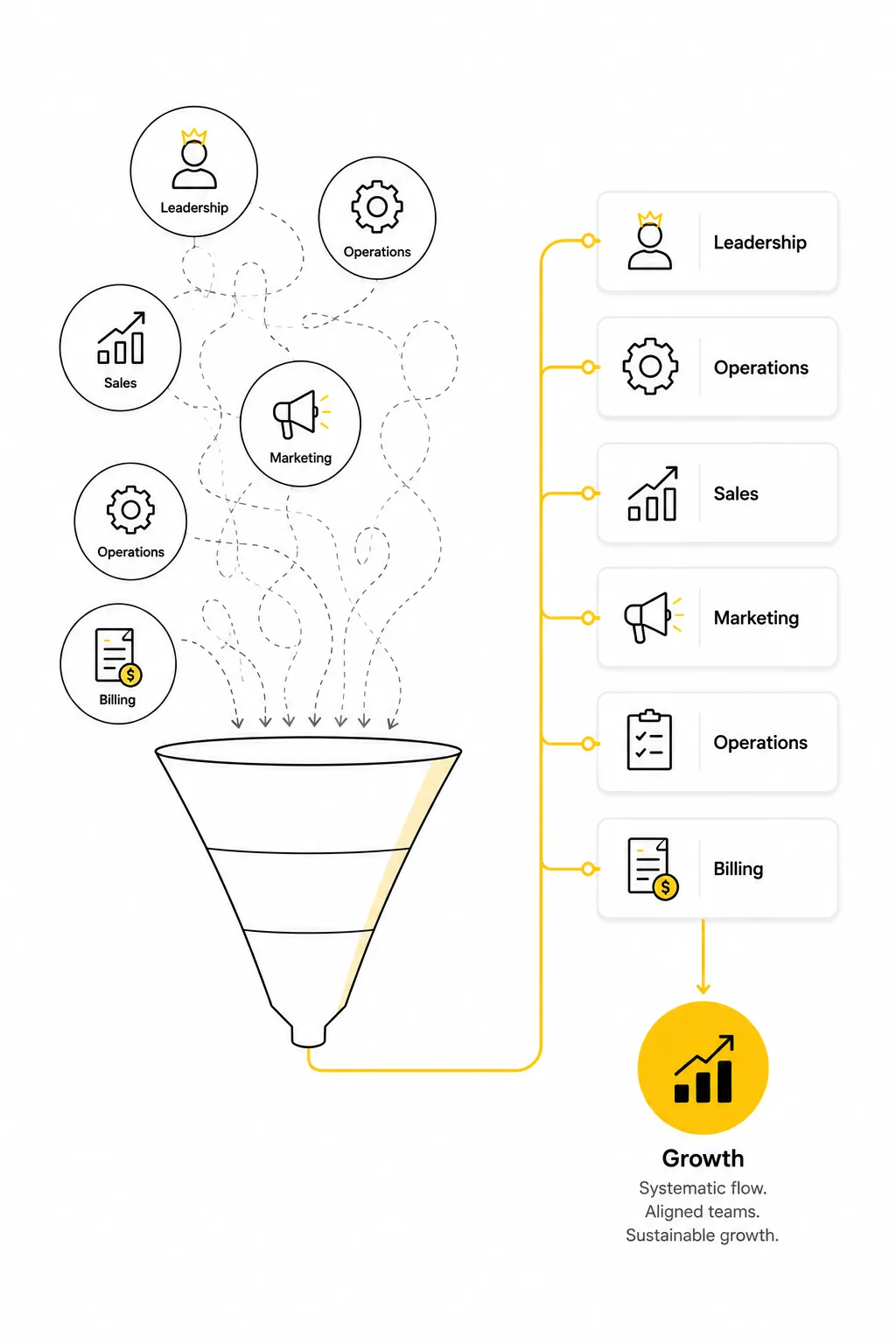
What is a CRM?
A Customer Relationship Management (CRM) system is software used to organise customer and prospect information.
A CRM can help your team:
Store contact and company information
Track leads and opportunities
Manage sales pipelines
Record calls, emails and interactions
Schedule tasks and follow-ups
Report on sales activity
Popular CRM platforms include Salesforce, HubSpot and GoHighLevel.
But having a CRM doesn't automatically mean you have a sales infrastructure.
What is sales infrastructure?
Sales infrastructure is everything working behind your sales team to capture, manage, follow up with and convert opportunities.
It can include:
CRM and pipeline
Lead capture
Sales processes
Follow-up workflows
Email and SMS communication
Lead qualification
Automation
Customer reactivation
Reporting and dashboards
Integrations between systems
Sales team responsibilities and handoffs
The CRM is one component.
The infrastructure is how all those components work together.
CRM vs Sales Infrastructure
CRM
Stores customer data
Tracks opportunities
Records activity
Provides pipeline visibility
Is primarily a software tool
Can be purchased and installed
Sales Infrastructure
Connects customer data to the sales process
Moves opportunities forward
Creates consistent actions and follow-up
Creates visibility across the revenue process
Is a combination of systems, processes, people and workflows
Needs to be designed around how the business actually sells
Why does the difference matter?
Many growing businesses already have a CRM.
The problem is that the CRM may not be properly connected to the rest of the sales operation.
You might have:
A CRM → but no consistent follow-up.
Lead forms → but no automated lead routing.
Quotes → but no follow-up process.
Customer data → but no reactivation campaigns.
Salespeople → but no clear next steps.
Reports → but no clear view of where revenue is being lost.
The result is a system that stores information without necessarily creating movement.
That's where sales infrastructure becomes important.
A CRM Doesn't Fix a Broken Sales Process
Buying a better CRM won't necessarily solve a sales problem.
If your process is unclear, your follow-up is inconsistent and your systems aren't connected, changing the software simply gives you a new place to have the same problems.
The question isn't:
“Which CRM should we use?”
It's:
“What needs to happen from the moment a lead enters our business until revenue is generated — and is our infrastructure making that happen consistently?”
What Does Good Sales Infrastructure Look Like?
A well-built sales infrastructure creates a connected journey:
LEAD → QUALIFY → FOLLOW UP → OPPORTUNITY → QUOTE → CLOSE → CUSTOMER → REACTIVATE / EXPAND
Every stage has:
A clear process
An owner
A next step
The right communication
The right data
Appropriate automation
Visibility for leadership
The goal isn't more technology.
The goal is fewer opportunities falling through the cracks and more revenue being captured from the opportunities you already have.
So, Do You Need a CRM or Sales Infrastructure?
For most established businesses, it's not an either/or decision.
You need a CRM as part of your sales infrastructure.
But if your business is growing and you're experiencing missed follow-ups, disconnected systems, poor pipeline visibility or too much manual sales administration, the bigger problem may be the infrastructure around your CRM.
At Scally, we look beyond the CRM to understand how sales, people, processes, systems and data work together and where that system is leaking revenue.
Ready to find your revenue leaks?
Find out where your sales and operational process is losing opportunities
and what infrastructure could recover them.
Copyrights 2026 | Scally Growth Partners™ | Terms & Conditions